What is a Cleanroom and Why Classification Matters
A cleanroom is a controlled environment where airborne particle concentration is continuously monitored and maintained within predefined limits. Cleanrooms are essential in industries where even microscopic particles can compromise research quality, product reliability, sterile conditions, or safety.
Cleanroom classification determines how “clean” the space must be based on the number and size of particles per cubic meter of air. The cleaner the room, the lower the ISO class rating — with ISO Class 1 being the cleanest environment achievable.
Choosing the correct cleanroom class is critical for regulatory compliance, contamination control, and operational efficiency. Incorrect classification can lead to product failure, regulatory penalties, or compromised research outcomes.
Looking for ISO Class 1 cleanroom solutions?
Explore HORIBA’s dedicated cleanroom solutions for semiconductor and advanced manufacturing applications.
Cleanroom Classification Standards: ISO 14644 vs. Fed-Std-209E
Historically, cleanrooms were categorized using the US Federal Standard 209E (using particles per cubic foot). Today, cleanrooms are classified using the more advanced ISO 14644-1 standard, which measures particles per cubic meter.
| Classification System |
Measurement |
Status |
| ISO 14644-1 |
Particles per cubic meter |
Current global standard |
| Fed-Std-209E |
Particles per cubic foot |
Superseded (still referenced informally) |
ISO classes range from Class 1 (ultra-clean) to Class 9 (least clean, comparable to ambient air).
Cleanroom Classification Chart – ISO Class 1 to Class 9
| ISO Class |
Max particles/m³ ≥0.1µm |
Typical Use Case |
| ISO 1 |
10 |
Lithography, nanotechnology, high-precision assembly, semiconductor R&D (KOACH technology enables ISO Class 1 in open space)
|
| ISO 2 |
100 |
Microchip manufacturing |
| ISO 3 |
1,000 |
Photolithography production |
| ISO 4 |
10,000 |
Advanced optical engineering |
| ISO 5 |
100,000 |
Pharmaceutical sterile manufacturing (Grade A), IVF labs |
| ISO 6 |
1,000,000 |
Medical device assembly |
| ISO 7 |
352,000 (≥0.5µm) |
General manufacturing, pharmacies |
| ISO 8 |
3,520,000 |
Controlled warehouse areas |
| ISO 9 |
Non-classified |
Normal room air |
Most traditional cleanrooms in pharma and manufacturing are ISO 5–7. However, industries like semiconductor, nano research and high-precision engineering are now demanding ISO Class 1–2 for next-gen innovation.
Upgrade to ISO Class 1 capability
See how KOACH-based cleanroom solutions can add ultra-clean zones to your existing facility layout.
Why ISO Class 1 is the Future of Critical Research & Manufacturing
ISO Class 1 represents the highest level of air cleanliness achievable, allowing just 10 particles of 0.1 microns per cubic meter — the same scale as virus-size contaminants. ISO Class 1 air quality enables highly precise tasks, which are extremely sensitive to even minimal contaminants.
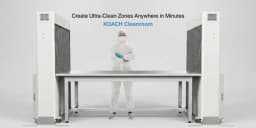
Historically, achieving ISO Class 1 required a complex, fully enclosed, and extremely power-consuming cleanroom setup. However,
HORIBA's KOACH cleanroom solutions
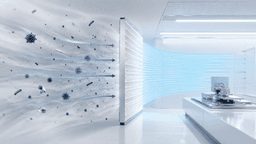
now enable ISO Class 1 conditions without walls or ceilings, using:
- FERENA nanofiber filtration (Better than ULPA-level performance) 99.9998% Removal of 0.15μm
- Purified Unidirectional Laminar Side-Airflow
- Strong capability to discharge particles or gases quickly
- Gentle Airflow (0.25 to 0.5m/per sec.)
- Localized contamination control
- Achieve the air cleanliness zone within 105–110 seconds
This breakthrough drastically reduces cleanroom project costs, space requirements, and deployment time, while allowing unrestricted work accessibility.
Traditional Cleanroom vs KOACH Open Cleanroom Technology
| Feature |
Traditional Cleanroom |
KOACH Open-System |
| ISO Levels Achievable |
Commonly ISO 5–8 |
ISO Class 1 |
| Uses Walls / Ceilings |
✔ Yes |
No |
| Startup Time |
Hours |
105–110 sec |
| Airflow Type |
Turbulent or Unidirectional |
Unidirectional Laminar Side-Airflow |
| Accessibility |
Limited |
Full, 360° |
| Power Consumption |
Very High |
Up to 1/3rd |
| Mobility |
No |
Yes |
| Construction Time |
6–16 weeks |
1 week (for 100 m²) |
Compare traditional rooms with KOACH cleanroom solutions
Evaluate power, flexibility and construction time benefits on our cleanroom solutions page.
How to Choose the Right Cleanroom Class for Your Facility
- Identify process contamination sensitivity (nano, biochemical, microbial, particulate).
- Refer to ISO classification for your industry.
- Factor in future innovation needs.
- Evaluate space, cost, and operational flexibility.
- Choose between full cleanroom OR localized clean zone control.
If your process requires access flexibility, fast setup, and ultra-high cleanliness — an open cleanroom solution may be better suited.
Recommended Solution for Modern Facilities
To support high-precision operations, combining localized ISO Class 1 zones (KOACH) within a broader ISO 5/6 cleanroom provides:
- ✔ Highest precision control
- ✔ Lower cost & power consumption
- ✔ Modular deployment for future expansion
Use Case Examples
Semiconductor Production (Lithography / FOUP handling)
- Eliminates risk of contamination while maintaining process accessibility.
- Used in pilot and R&D labs deploying localized ISO Class 1 zones.
IVF & Cell Lab Systems
Pharmaceutical Sterility
- Ideal for sensitive aseptic operations.
Precision Assembly
- Allows uninterrupted hand movement without contamination risk.
Technology Behind KOACH
- FERENA nanofiber filters
- Unidirectional Laminar Side-Airflow through Push hoods
- Laminar flow collision principle
- Local capture and expulsion of particles
- Mobile and rapid setup
Final Thoughts
With increasing demands in semiconductor, pharma R&D, biotechnology, medical devices & advanced manufacturing, cleanroom requirements are evolving rapidly.
- Traditional ISO 5–7 cleanrooms are no longer sufficient for emerging technologies
- ISO Class 1 is becoming mission-critical
-
HORIBA's KOACH technology
makes ISO Class 1 accessible, modular, and practical
Plan your next cleanroom with HORIBA
Discover how KOACH-based cleanroom solutions can help you achieve ISO Class 1 conditions with flexibility and lower lifecycle costs.