Invisible Threats, Massive Yield Losses: Understanding Micro-Contamination and Particle Dynamics in High-Precision Cleanrooms

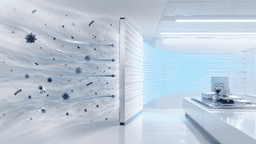
In high-precision manufacturing, what you cannot see can quietly ruin your entire production line.
While visible dust particle those floating in a sunbeam or settling on a desk range from 50 to 100 micrometres (μm) in diameter, the most destructive contaminants in Cleanroom Environments are microscopic. Airborne particles measuring 0.1 μm, 0.5 μm, and 5.0 μm are completely invisible to the human eye, yet they hold the power to cause Catastrophic Yield Losses, Electrical Shorts, Optical Scattering, and Batch failures in industries ranging from Semiconductor fabrication to Medical Device Assembly.
Understanding Micro-Contamination requires looking beyond more than particle counts to examine the physical behaviour, sources, and industry impacts of specific particle size fractions.
1. Defining the Scale: How Small Is Micro-Contamination?
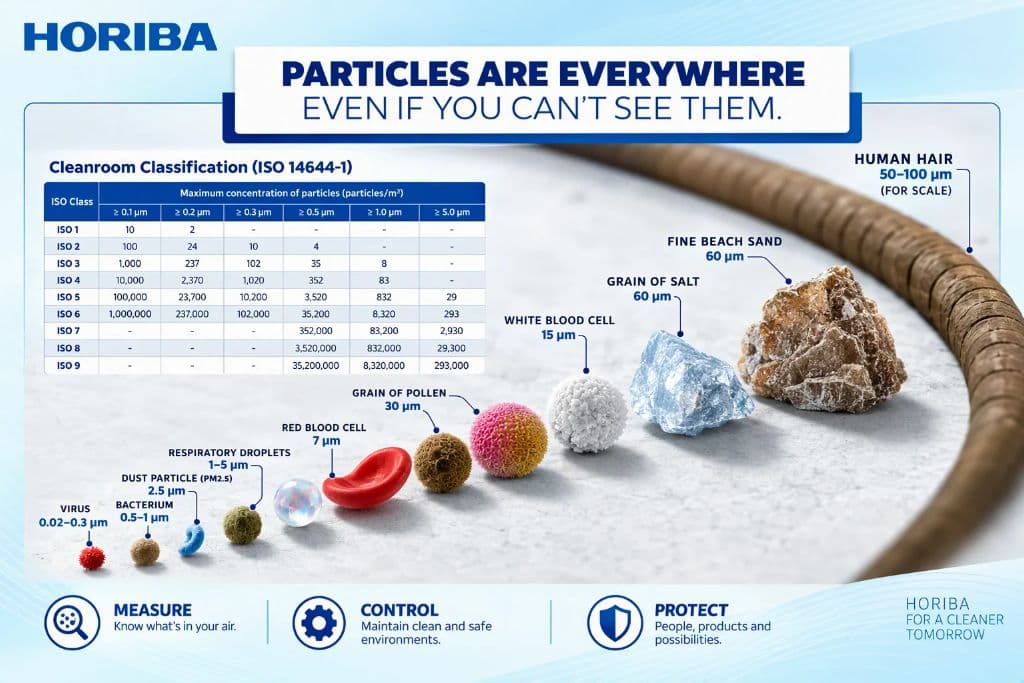
To grasp the physics of Cleanroom Contamination Control, Consider the micrometre scale (1 μm=0.001 mm):
- Human Hair: ~70 to 100 μm in diameter.
- Pollen Grain: ~30 to 50 μm.
- RBC (Red Blood Cell): ~6 to 8 μm.
- 5.0 μm Particle: Coarse airborne dust, large skin flakes, and heavy bacterial clusters.
- 0.5 μm Particle: Fine particulate matter, isolated bacteria, aerosol droplets, and combustion by products.
- 0.1 μm Particle: Sub-micron particulate matter, viral fragments, skin lipid residues, and smoke condensation.
2. Particle Size Breakdown: Behaviour, Origins, and Cleanroom Dynamics
Cleanroom classification standards, such as ISO 14644-1, evaluate airborne cleanliness based on concentration limits for specific particle size thresholds. Each particle size class exhibits distinct physical behaviours and originates from different contamination vectors.
| Particle Size (μm) | Settling Velocity / Behaviour | Primary Cleanroom Sources | Primary Impact Mechanisms |
|---|---|---|---|
| 5.0 μm | Fast gravity settling (~0.07–0.1 cm/s); prone to impaction | Human skin shedding, gowning breakdown, mechanical friction | Physical bridging, mechanical jams, surface fouling |
| 0.5 μm | Slow gravity settling; strongly influenced by airflow patterns | Human respiration, HVAC leaks, ambient air infiltration | Wafer pattern defects, optical scattering, sterile compromise |
| 0.1 μm | Negligible settling; governed by Brownian motion | Chemical outgassing, high-temp processes, friction wear | Gate oxide breakdown, nanoscale short circuits, film defects |
3. High-Precision Sector Impacts: Where Micro-Dust Destroys Value
Semiconductor & Microelectronics
Modern integrated circuits feature feature sizes below 10 nanometres. When an airborne particle 0.1 μm or larger lands on a silicon wafer during critical fabrication steps:
- Photolithography: It casts a shadow, causing pattern distortion.
- Thin-Film Deposition: It creates voids or pinholes in insulating layers, causing gate oxide breakdown.
- Etching: It acts as a micro-mask, leaving unwanted material behind and short-circuiting microchips.
The financial impact is direct: a single contamination event in a high-volume fab can drop batch yields from 95% to 0% within minutes, costing millions of dollars in lost silicon.
Automotive Electronics & Lithium-Ion Battery Assembly
As vehicles transform into supercomputers on wheels, automotive cleanroom standards have tightened drastically:
- Li-Ion Batteries: Airborne metallic particles as small as 5.0 μm can puncture the ultra-thin separator film between the cathode and anode, triggering internal short circuits, thermal runaway, and battery fires.
- LiDAR & Radar Sensors: Micro-dust settled on optical lenses scatters infrared light, blinding autonomous driving algorithms and creating safety hazards.
Optics, Photonics, and Space Systems
High-power lasers, Satellite Optics, and Aerospace Sensors depend on absolute surface purity:
- Laser Damage: A 0.5 μm particle on a high-power laser mirror absorbs energy, heats up instantaneously, and causes localized thermal damage that destroys the optic.
- Outgassing & Condensation: Sub-micron contaminants that vaporize under space vacuum re-condense on cold detector surfaces, obscuring faint optical signals from satellite payloads.
4. Mitigation Strategies: Engineering Out Micro-Contamination
Controlling 0.1 μm to 5.0 μm particles require a multi-layered engineering approach:
- High-Efficiency Filtration (HEPA, ULPA & FERENA): Standard HEPA filters capture 99.97% of particles down to 0.3 μm. For sub-micron protection, ULPA (Ultra-Low Penetration Air) filters deliver 99.9995% efficiency at 0.12 μm, targeting the Most Penetrating Particle Size (MPPS). Advanced FERENA Filters delivers 99.9998% of 0.15μm with Low Air Resistance.
- Unidirectional Laminar Airflow: Utilizing continuous, non-turbulent laminar airflow pushes airborne particles downward and away from critical work surfaces before Brownian diffusion or electrostatic attraction causes them to land on active products.
- Electrostatic Control (Ionization): Because sub-micron particles carry static charges, electrostatic attraction draws them toward non-conductive surfaces. Installing room ionization systems neutralizes static charges on both particles and product substrates.
- Continuous Real-Time Monitoring: Deploying multi-channel Remote Discrete Particle Counters (DPCs) allows facilities to continuously track particle concentrations across 0.1 μm, 0.5 μm, and 5.0 μm channels, providing instant alerts the moment airborne levels spike.
Results
Micro-contamination is an invisible adversary, but its financial and operational consequences are overwhelmingly visible. Whether dealing with the gravitational settling of 5.0 μm coarse particles or the stubborn, Brownian wander of 0.1 μm sub-micron debris, understanding particle dynamics is the first step toward maintaining yield purity, regulatory compliance, and product reliability.
In high-precision manufacturing, clean air is not just an operational preference—it is a core technical requirement.
Plan your next Cleanroom with HORIBA India.
Discover how our Cleanroom Solutions can help you achieve high cleanliness conditions with flexibility and lower lifecycle costs.