Quick Answer
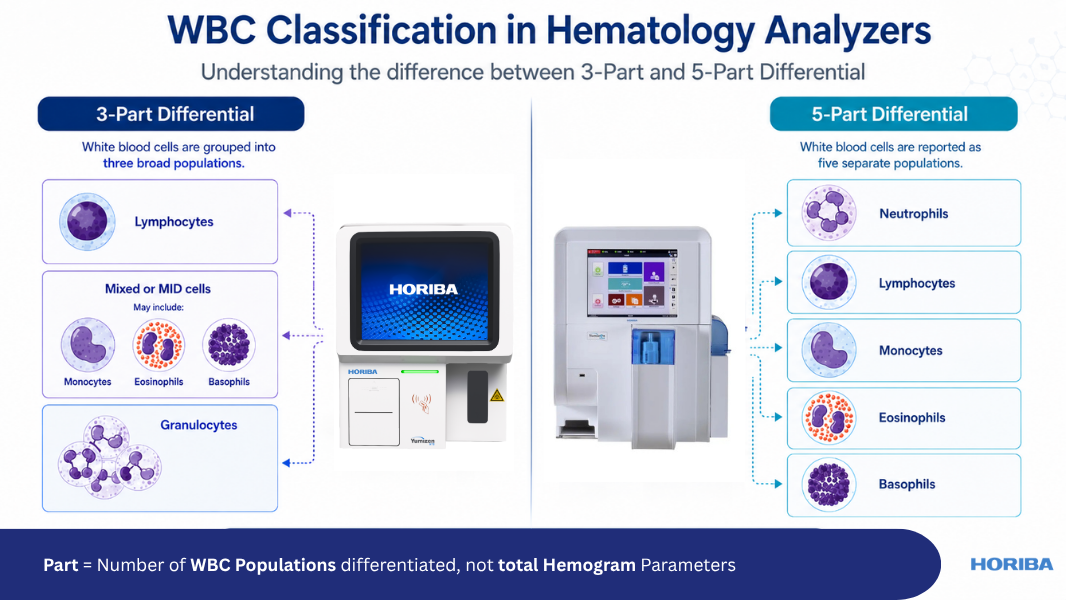
- The term “part” refers to the number of major white blood cell populations differentiated by the analyzer.
- A 3-part hematology analyzer usually reports lymphocytes, mixed or middle cells, and granulocytes.
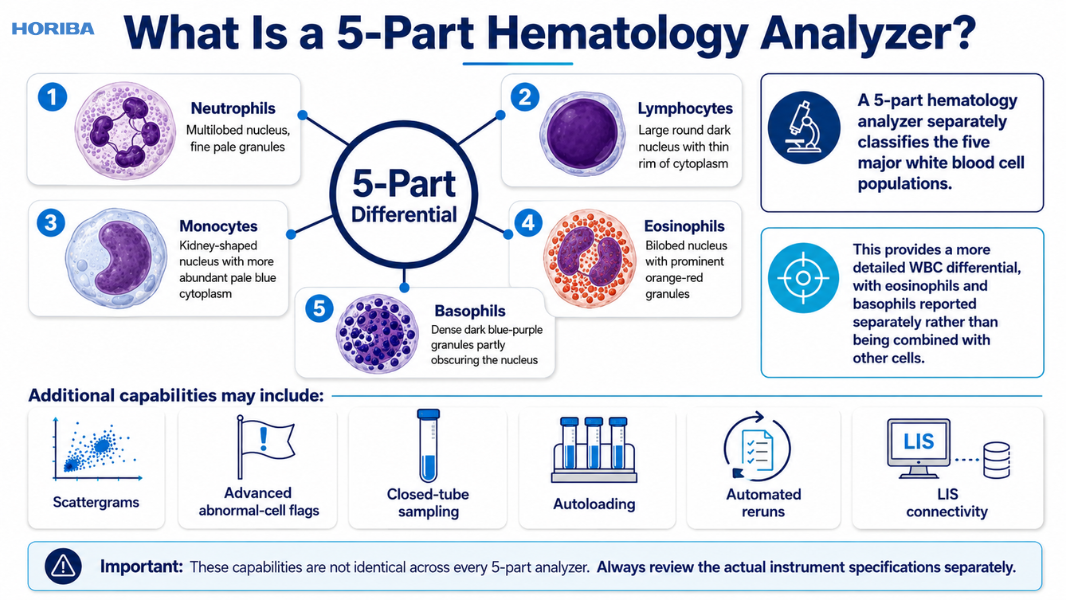
- A 5-part hematology analyzer separately reports neutrophils, lymphocytes, monocytes, eosinophils and basophils.
- A 5-part analyzer provides a more detailed WBC differential, but it is not automatically the correct option for every laboratory.
What Does “Part” Mean in a Hematology Analyzer?
Both 3-part and 5-part hematology analyzers measure a range of complete blood count parameters, including white blood cells, red blood cells, haemoglobin, haematocrit, platelet count and red blood cell indices.
The term “part” refers specifically to the way white blood cells, or leukocytes, are classified into different populations. These cell types perform distinct roles in immune defence, inflammation and allergic responses.
Hematology analyzers differentiate white blood cells by evaluating measurable characteristics such as cell size, internal complexity, granularity and reaction to specific reagents. Based on the number of white blood cell populations reported, the system is classified as either a 3-part or 5-part analyzer.
What Is a 3-Part Hematology Analyzer?
A 3-part hematology analyzer divides white blood cells into three broad groups. The terminology may vary slightly between manufacturers, but the populations are generally reported as:
- Lymphocytes
- Mixed or middle-cell population
- Granulocytes
The mixed-cell population may be labelled as MID, MXD or sometimes MON, depending on the analyzer. This group can contain monocytes, eosinophils and basophils that are not individually separated.
The granulocyte population is also a broad group. It is usually dominated by neutrophils but may also include other granulocytic cells. Therefore, it should not automatically be interpreted as a completely isolated neutrophil result.
Where is a 3-part analyzer commonly used?
A 3-part analyzer can be suitable for laboratories where the primary requirement is routine CBC screening and a broad WBC differential is sufficient for most samples.
Common advantages
- Relatively simple operation
- Compact instrument footprint
- Generally lower reagent consumption
- Lower initial and operating cost
Important limitations
- No separate eosinophil result
- No separate basophil result
- Broader WBC grouping
- Complex samples may require further review
What Is a 5-Part Hematology Analyzer?
A 5-part hematology analyzer separately classifies the five major white blood cell populations:
- Neutrophils
- Lymphocytes
- Monocytes
- Eosinophils
- Basophils
Depending on the analyzer model, a 5-part system may also provide scattergrams, advanced abnormal-cell flags, closed & Open tube sampling, autoloading and stat loading, automated reruns and laboratory information system connectivity.
These capabilities are not identical across every 5-part analyzer. The instrument’s actual specifications should always be reviewed separately.
Difference Between 3-Part and 5-Part Hematology Analyzers
| Comparison Factor | 3-Part Analyzer | 5-Part Analyzer |
|---|---|---|
| WBC differentiation | Three broad populations | Five separate populations |
| Typical reporting | Lymphocytes, MID/MXD and granulocytes | Neutrophils, lymphocytes, monocytes, eosinophils and basophils |
| Eosinophils | Usually included in a combined population | Reported separately |
| Basophils | Usually included in a combined population | Reported separately |
| Clinical detail | Suitable for routine CBC screening | Provides a more detailed leukocyte differential |
| Measurement approach | Commonly uses electrical impedance and size-based histograms | May combine impedance with optical, scatter-based or cytochemical methods |
| Complex samples | More samples may require smear review or additional testing | Greater differentiation can support more targeted review |
| Reagent requirements | Generally simpler | May require additional reagents |
| Operating cost | Generally lower | Generally higher, depending on configuration |
| Typical laboratory | Clinics and routine laboratories | Hospitals and more complex testing environments |
How Do Their Analysis Methods Differ?
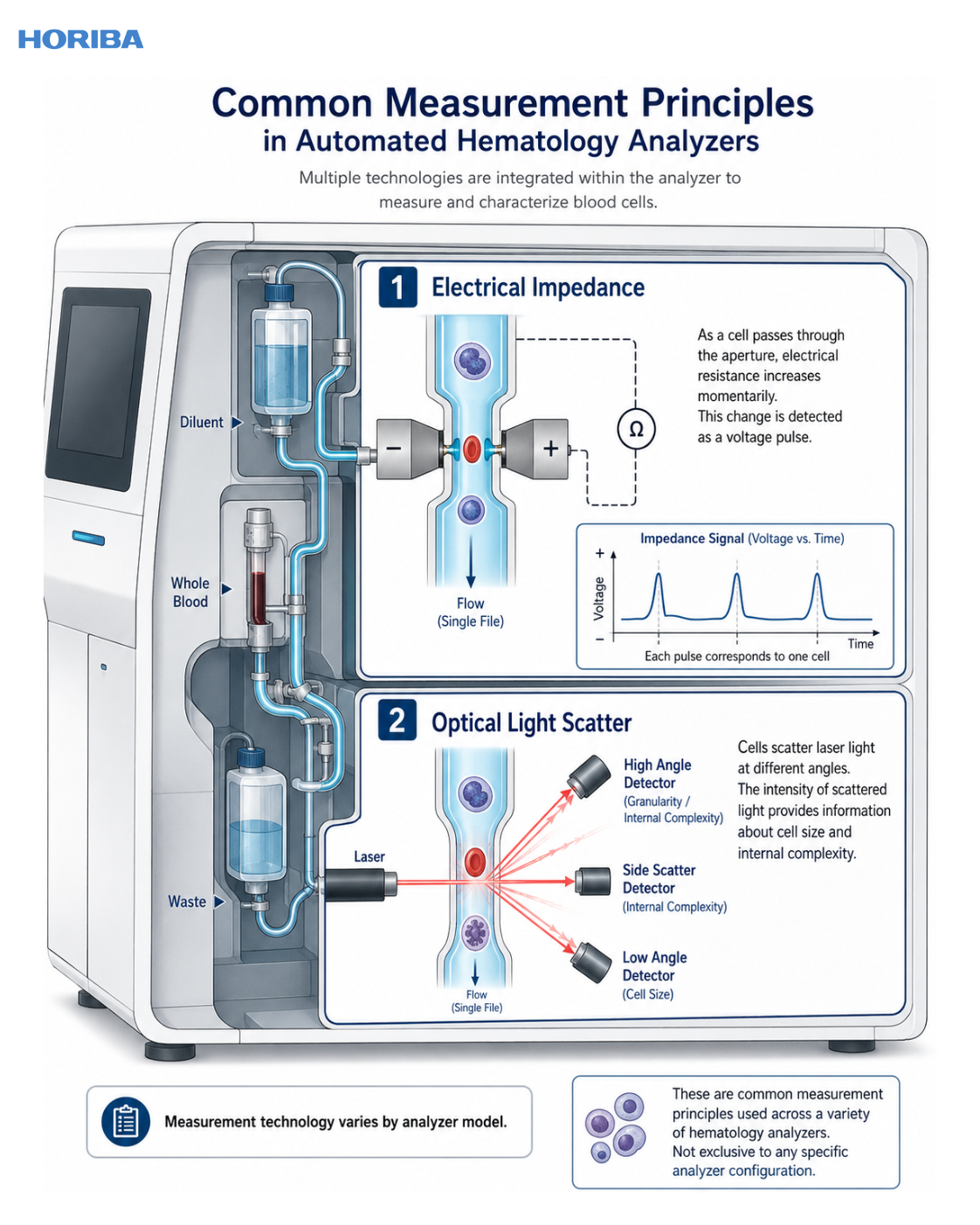
Automated hematology analyzers classify cells using measurable physical and optical characteristics. The precise combination of technologies differs by analyzer model.
Electrical impedance
In electrical impedance measurement, diluted blood cells pass one by one through a small aperture positioned between electrodes. As each cell passes through the aperture, it temporarily changes the electrical resistance.
The analyzer records this change as an electrical pulse. The number of pulses relates to the number of cells, while pulse size can provide information about cell volume.
This information can be used to create histograms and classify cells into broader groups according to their size distribution.
Optical light-scatter analysis
In optical analysis, cells travel in a controlled stream through a focused light beam. Detectors measure how light is scattered at different angles.
These optical signals can provide information associated with cell size, internal complexity and granularity. Many 5-part analyzers use optical information together with impedance, reagents or other analytical methods to separate WBC populations.
5-part hematology analyzers may use different methodologies for measuring specific parameters, such as electrical impedance for cell counting and fluorescence flow cytometry or optical light scatter for white blood cell differentiation.
Why Does the Additional WBC Differentiation Matter?
Separate eosinophil reporting
Eosinophil results can provide useful information in the investigation of allergic, parasitic and inflammatory conditions. A 3-part analyzer generally includes eosinophils within a combined group, while a 5-part analyzer reports them separately.
Separate basophil reporting
Basophils normally represent a small proportion of circulating white blood cells. Separate basophil reporting can provide additional information in selected clinical and haematological malignancies.
More targeted smear review
A detailed WBC differential, scattergrams and analyzer flags may help laboratories identify samples that need further microscopic review. This can support a more targeted review process, particularly where the laboratory handles complex patient samples.
How to Choose Between a 3-Part and 5-Part Analyzer
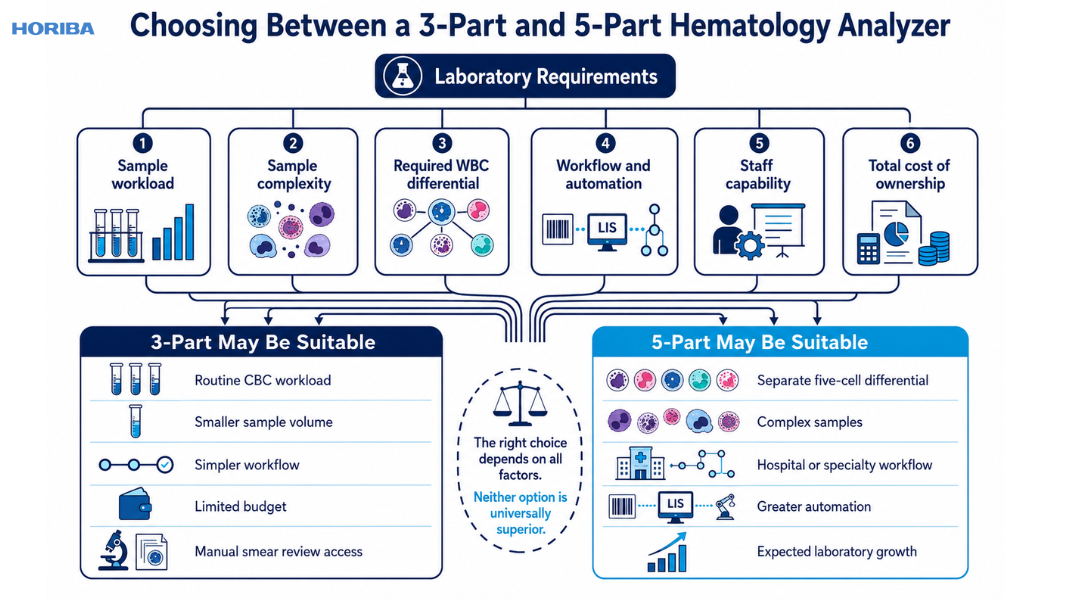
The most appropriate analyzer depends on the laboratory’s clinical, operational and financial requirements. Selection should not be based only on instrument price or the total number of reported parameters.
Purchase Price vs Total Cost of Ownership
A 3-part analyzer generally has a lower purchase price and lower reagent requirements. A 5-part analyzer may involve a higher initial investment and more complex reagent consumption.
However, purchase price alone does not show the true operating cost. A laboratory should also account for direct and indirect costs over the analyzer’s useful life.
Direct costs
- Analyzer purchase price
- Reagents and consumables
- Controls and calibrators
- Service contracts and spare parts
- Software and connectivity
Indirect costs
- Manual smear-review time
- Repeat analysis
- Referral testing
- Analyzer downtime
- Staff training and overtime
Frequently Asked Questions
What is the main difference between a 3-part and 5-part analyzer?
A 3-part analyzer reports three broad WBC populations, while a 5-part analyzer separately reports neutrophils, lymphocytes, monocytes, eosinophils and basophils.
Is a 5-part analyzer more accurate than a 3-part analyzer?
A 5-part analyzer provides more detailed WBC differentiation, but overall analytical accuracy depends on the specific instrument, calibration, quality control, sample condition and laboratory procedures.
Does a 3-part analyzer report neutrophils?
A typical 3-part analyzer reports a broad granulocyte population rather than fully separating neutrophils, eosinophils and basophils.
Does a 5-part analyzer replace peripheral smear examination?
No. Samples with abnormal flags, unexpected results or clinically suspicious findings may still require microscopic smear review.
Are all 5-part analyzers high-throughput systems?
No. Five-part analyzers are available as compact benchtop, autoloading and high-throughput systems. Differential type and throughput should be evaluated separately.
Which analyzer is suitable for a small laboratory?
A 3-part analyzer may be sufficient for routine, lower-complexity workloads. A compact 5-part analyzer may be appropriate when separate WBC populations or more detailed flags are required.