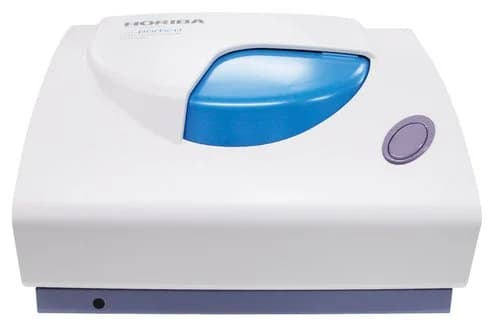
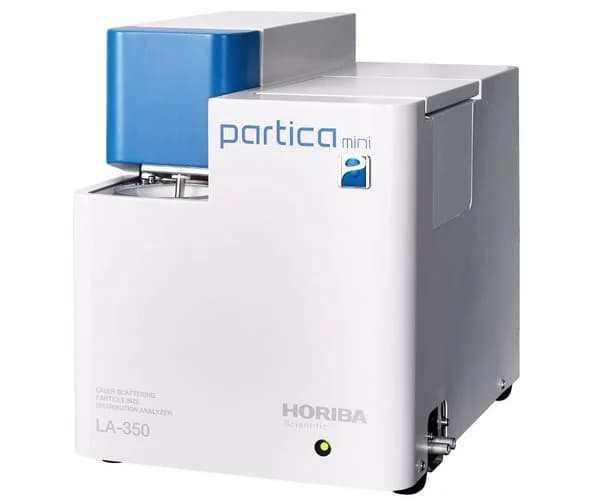
Unmatched Accuracy & Precision
Measures NIST-traceable standards with <1% deviation; fully compliant with ISO 13320.


HORIBA offers instruments for particle size, particle shape, zeta potential, molecular weight, and surface area analysis. A range of analytical techniques are employed including laser diffraction (Mie Theory), dynamic light scattering, nanoparticle tracking analysis (NTA) and dynamic & static image analysis (for determining both particle size and shape information).
HORIBA’s Particle Size Analyzers turn these techniques into practical results—delivering precise, repeatable size distributions from the nanometer to millimeter range with automatic laser alignment, rapid one-button workflows, and optimized wet & dry dispersion. Reporting aligns with ISO 13320 (D10/D50/D90) and results are verified with NIST-traceable standards for R&D and QC across pharma, energy & environment, materials, printing, coatings, and construction.
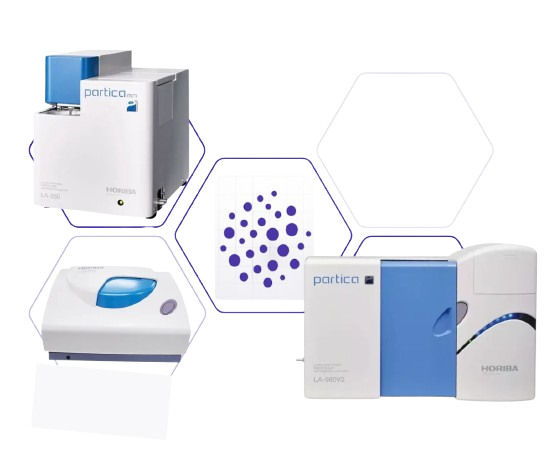
Measures NIST-traceable standards with <1% deviation; fully compliant with ISO 13320.
Automatic laser alignment in seconds and one-button workflows for rapid, reliable runs.
Wet & dry dispersion, Smart Scans (trigger), and self-adjusting powder flow.
Instrument-to-instrument agreement minimizes correlation across labs, operators, and sites.
BOOK A CONSULTATION
Our experts are here to guide you to the right solution. Fill out the form and we'll get in touch shortly.
A particle size analyzer measures the size distribution of particles in a sample. Accurate sizing improves product quality, process yield, stability, and regulatory compliance across R&D and manufacturing.
For broad, multi-modal distributions and routine QC, laser diffraction (static light scattering) is ideal. Use wet dispersion for suspensions/slurries and dry dispersion for free-flowing powders. (Talk to our experts if you’re unsure.)
We cover nanometer to millimeter scales depending on configuration and dispersion mode, addressing both fine powders and larger granules.
They are percentile diameters of the distribution: D10 (10% of particles are smaller), D50 (median), D90 (90% are smaller). These metrics summarize your sample quickly and are referenced in ISO 13320.
Using NIST-traceable standards, the system achieves accuracy as low as ~0.6% vs specification, with excellent repeatability and instrument-to-instrument agreement across sites.
Yes. Our methods and reporting follow ISO 13320 recommendations, including evaluation on D10, D50, D90 and validation with certified standards.
Use wet for agglomeration-prone or submicron samples and to control refractive index/dispersant. Use dry for free-flowing powders or when solvents are undesirable. We support both with optimized accessories.
Typical runs need only a small amount (varies by mode). Smart Scans (Trigger) help measure limited/precious samples accurately.
Wet measurements can be completed in under 60 seconds sample-to-sample, thanks to automated filling, circulation, ultrasonication, and one-button workflows.
Pharma & healthcare, energy (fuel-cell catalyst inks), printing & imaging (toner), paints & coatings (CaCO₃), construction (cement, asphalt emulsions), chemicals/materials, and more.