

Nanolog
Nanotechnology EEM Spectrofluorometer
Your best answer to analyzing your mixtures of nanomaterials whether single-walled carbon nanotubes, quantum dots, or nanocrystals. Optimized for detecting nanomaterials near-IR fluorescence, the Nanolog® modular spectrofluorometer can help you determine their composition and structure. Based on the proven technology of the world-renowned Fluorolog® from HORIBA, the Nanolog is designed to give you a long life of reliable service and expert assistance.
Why Choose Nanolog
- Wide spectral detection — Photomultiplier tubes (UV to 1750 nm) & solid-state photodiodes (IR to 2400 nm); Rapid EEM acquisition — CCD arrays for fast fluorescence fingerprinting
- NIR sensitivity — InGaAs arrays for near-IR EEM detection
- Modular configuration — Customizable monochromators, compartments & detectors
- Self-calibrating automation — Automated alignment & control via FluorEssence™ software
- Advanced nanotube analysis — Nanosizer™ integration for SWCNT chirality & diameter determination

Key Advantages of Nanolog
1.
High-speed EEM acquisition
<1 s per spectrum
Enables rapid sample throughput
2.
Extended spectral range
200–2400 nm coverage
Supports UV to NIR applications
3.
Ensures consistent results
Automated reproducibility
Self-calibrating FluorEssence™ software
4.
Tailors to diverse experiments
Modular flexibility
Configurable excitation & detection modules
Applications of Nanolog
Optical properties of carbon nanotubes
Single-wall carbon nanotubes, consisting of rolled-up single sheets of carbon atoms, have received much attention recently due to its excellent electronic properties, which can be probe using Nanolog spectrofluorometer.
Photoluminiscence of SWCNT
Most research into single-wall carbon nanotubes has been focused on individual tubes. Recent study shows that using Nanolog series the electronic properties of SWCNT bundles using photoluminescence spectroscopy.
NIR-photoluminiscence of quantum dots
Nanolog spectrometer, specially optimized for recording near-IR fluorescence from nanoparticles.
Measurement of silica nanoparticles via fluorescence anisotropy
Silica is one of the most important industrial materials whose nanoparticle are formed via a spl-gel process.
Nanophotonics
Nanolog has many applications in nanophotonics research. For examples, single-wall carbon nanotubes, OLEDs & Quantum dots.
Technical Specifications of Nanolog
Nanolog Specifications
All-reflective optics Nanolog fluorescence spectrometer for perfect focus at all wavelengths from the UV to NIR
| Excitation Sources | Choice of:
Note: The Sensitivity Specification listed below is the same with either the 450 W xenon or the 75 W xenon due to the enhanced collection efficiency of the PowerArc! | |
| Excitation Monochromators | Choice of:
Note:Specifications hereare basedon 180mm monochromator withstandard 1200grooves/mm gratingblazed at 330nm. Othergratings areavailable. | |
| Resolution: 0.2 nm | ||
| Accuracy | 0.5 nm | |
| Speed | 150 nm/s | |
| Range | 0–1300 nm mechanical range; throughput based on grating’s blaze | |
| Bandpass | Set automatically (0–30 nm single-grating, 0–15 nm double-grating) | |
| Sample Compartment | All reflective optics sample compartment with single cuvette sample compartment tray for quick replacement with variety of optional sample hold- ers. Reference photodiode for excitation correction from 240–1000 nm. Optional front-face detection for highly turbid samples in solution. Optional T-Format detection to allow optional second emission-detection channel. | |
| Emission Imaging Spectrograph | iHR320, for multi-channel acquisition, with triple-grating turret. Can be configured with one or two exit ports each for multi-channel or single channel detectors. Equipped with 150 grooves/mm grating for multi-channel detection of entire emission spectra with a single acquisition. | |
| Resolution | 0.2 nm | |
| Accuracy | 0.3 nm | |
| Range | 0–1500 nm mechanical range (using a 1200 grooves/mm grating and single channel detector) | |
| Multichannel Detectors | Choice of up to two of the following:
| |
| Optional T-Side Emission Monochromator for Single Channel Detectors | Specifications are the same as excitation monochromator above1 | |
| Single Channel Detectors | Choice of:
| |
| Software | Windows™-based FluorEssence™ software supplies all scanning, time-based, and accessory data acquisition plus complete control of all hardware, plus Nanosizer™ for fitting of single-walled carbon nanotube spectra to known library to determine chiralities and diameters. | |
| Sensitivity | Water Raman Signal-to-Noise Ratio of 15,000:1 (FSD method), 350 nm excitation, 5 nm bandpass, 1 second integration, no filters or averaging, with R928P photomultiplier tube. | |
Recommended configurations
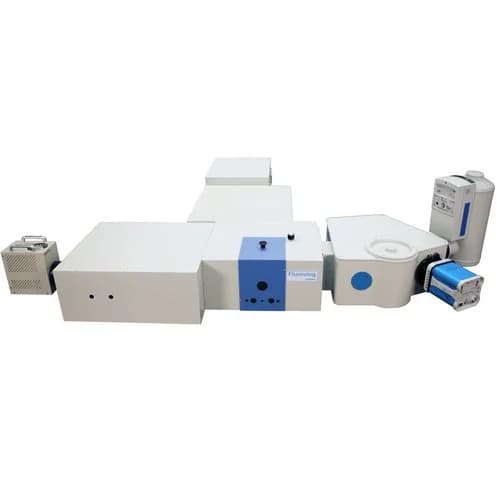
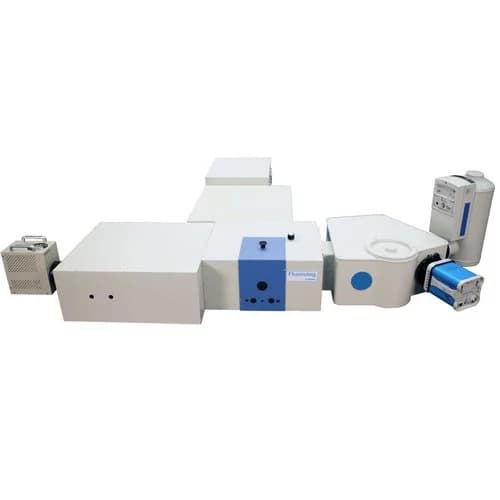
The Nanolog 3-22-iHR, pictured here, is configured with a double-grating excitation and emission monochromator, plus an imaging spectrograph for a second emission channel.
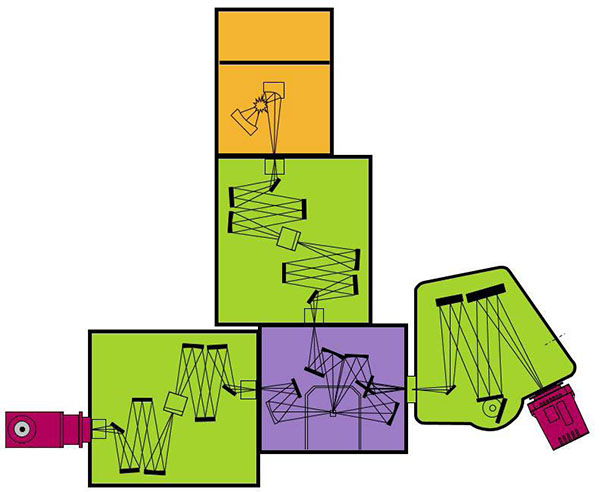
Schematic shows a highly versatile Nanolog equipped with a 450 watt xenon lamp housing, double excitation monochromator for ultimate stray light rejection, T-Format sample compartment with multichannel iHR320 imaging spectrograph equipped with a Symphony NIR InGaAs array detector and a T-Side double emission monochromator with a PMT detector for ultimate sensitivity and stray light rejection.
Related Products
Explore other high-performance analyzers that might fit your lab’s needs.
NOT SURE WHAT YOU ARE LOOKING FOR?
BOOK A CONSULTATION
Our experts are here to guide you to the right solution. Fill out the form and we'll get in touch shortly.