
TPNA-500
Automatic Total Nitrogen/Phosphorus Monitoring System
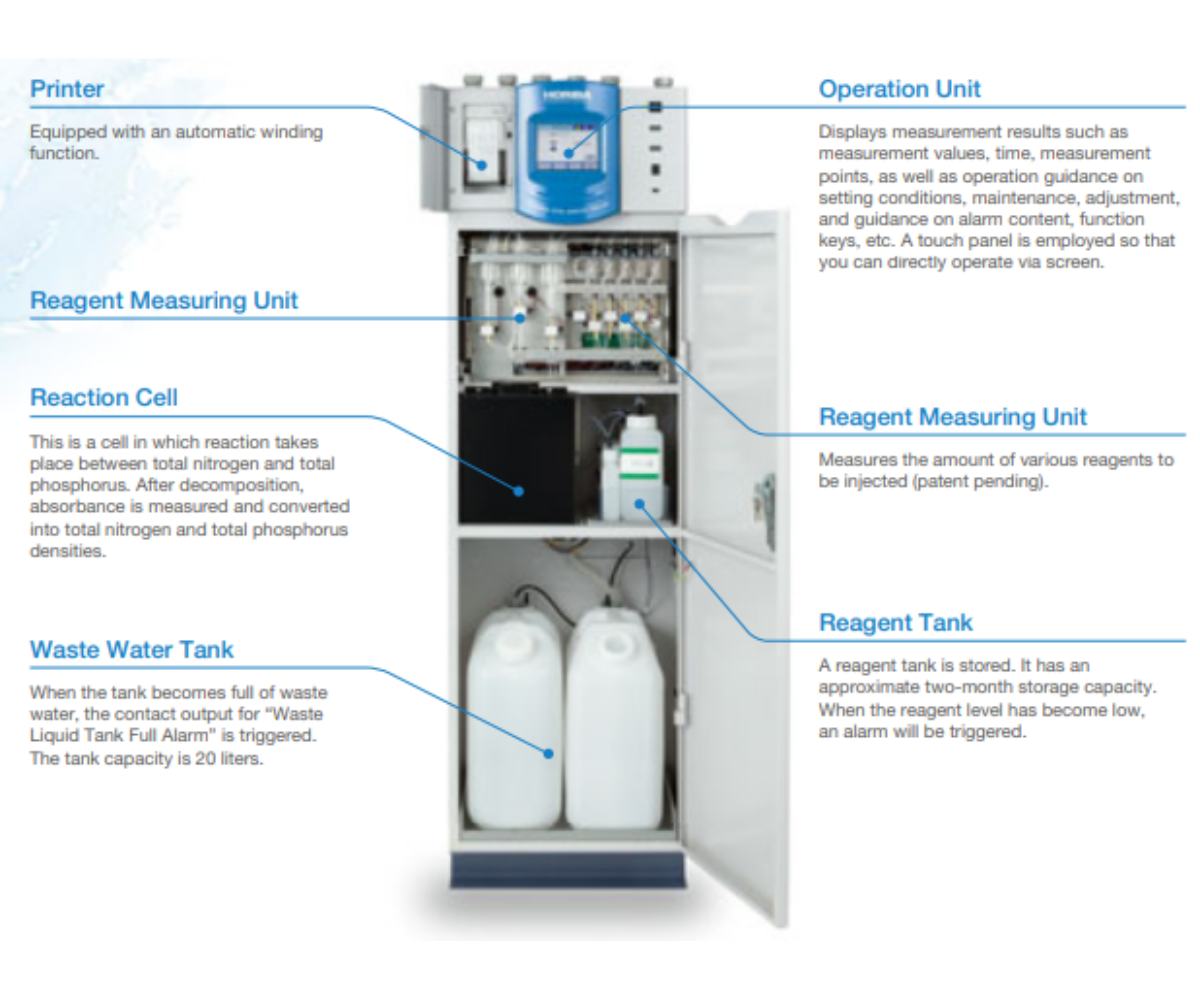
The TPNA-500 Automatic Total Nitrogen/Phosphorus Monitoring System is an advanced online analyzer designed for continuous monitoring of total nitrogen (TN) and total phosphorus (TP) to support regulatory compliance and total emission control. Developed by combining 60 years of HORIBA water measurement technology, the TPNA-500 is engineered to reduce life cycle cost (LCC) while enhancing operational reliability and corporate compliance.
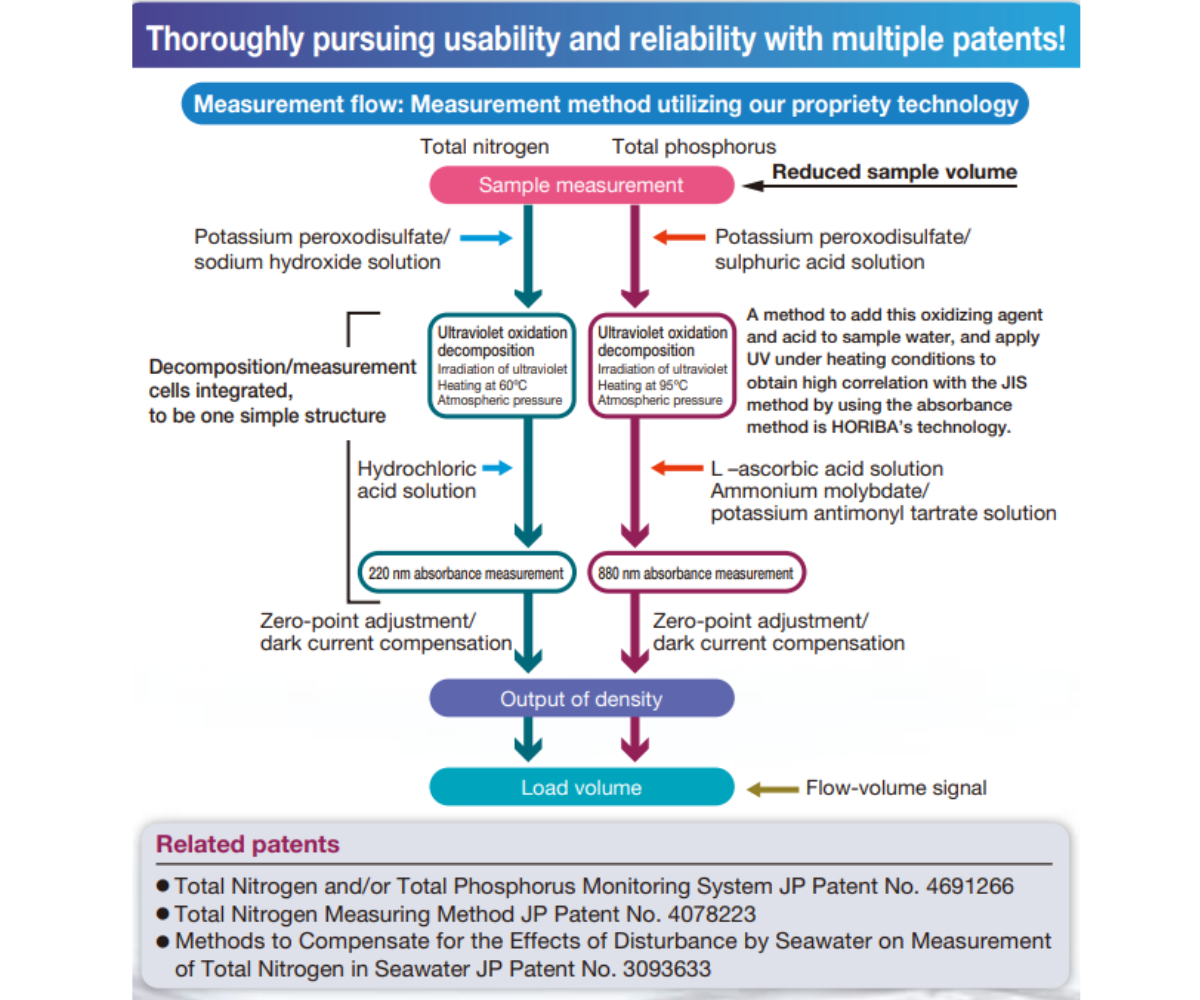
This total nitrogen and total phosphorus analyzer utilizes ultraviolet oxidative decomposition technology with spectrophotometric detection to achieve accurate measurement of nitrogen and phosphorus concentrations in wastewater and industrial effluent. The system supports load calculation, real-time monitoring, and data logging, enabling proactive environmental management beyond regulatory compliance.
Designed for indoor installation, the TPNA-500 operates at a 60-minute measurement cycle and supports single or dual measurement points with optional multi-range configuration. Its optimized reagent consumption, reduced power usage (approximately 30% reduction), and halved pure water and waste liquid volume contribute to lower operational cost and reduced environmental impact.
With integrated touch panel operation, built-in printer, Modbus communication, and extensive input/output capabilities, the TPNA-500 total nitrogen and phosphorus monitoring system provides reliable long-term performance for environmental monitoring facilities.
Why Choose TPNA-500
- Achieves Life Cycle Cost (LCC) reduction through optimized reagent usage and reduced maintenance man-hours
- Ultraviolet oxidation decomposition method with proven industry adoption
- Reduced power consumption (~30%) and pure water/waste water usage reduced to half
- Extension of reagent replacement cycle to two months (depending on conditions)
- Built-in load calculation for TN and TP (optional COD load calculation)
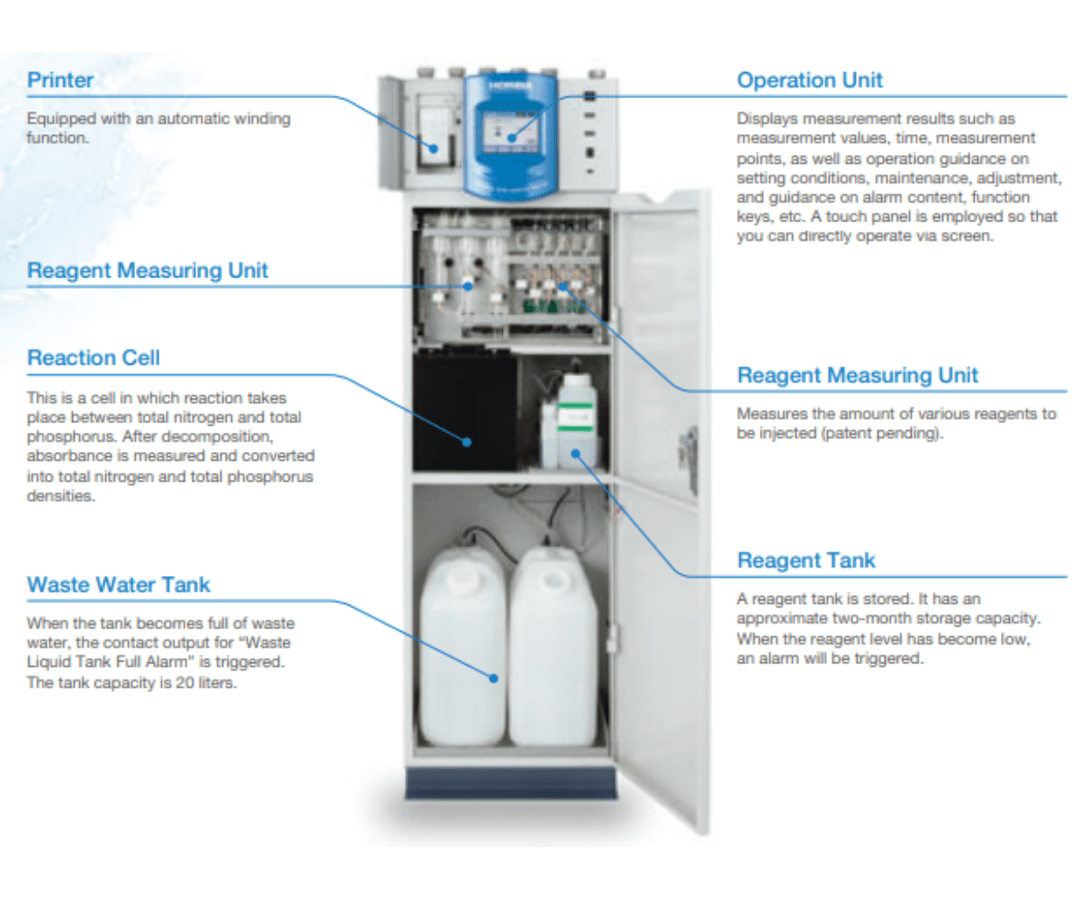
- Touch panel color LCD with on-screen operation guidance and alarm display
- Integrated printer with automatic take-up device
- Modbus communication and USB data export capability
- Compatible with previous TPNA-300 / PN-100 channel base

Key Advantages of TPNA-500
1.
Life Cycle Cost Reduction
Optimized reagent volume, reduced power consumption, and decreased pure water and waste liquid usage lower overall operating cost.
2.
Ultraviolet Oxidative Decomposition Technology
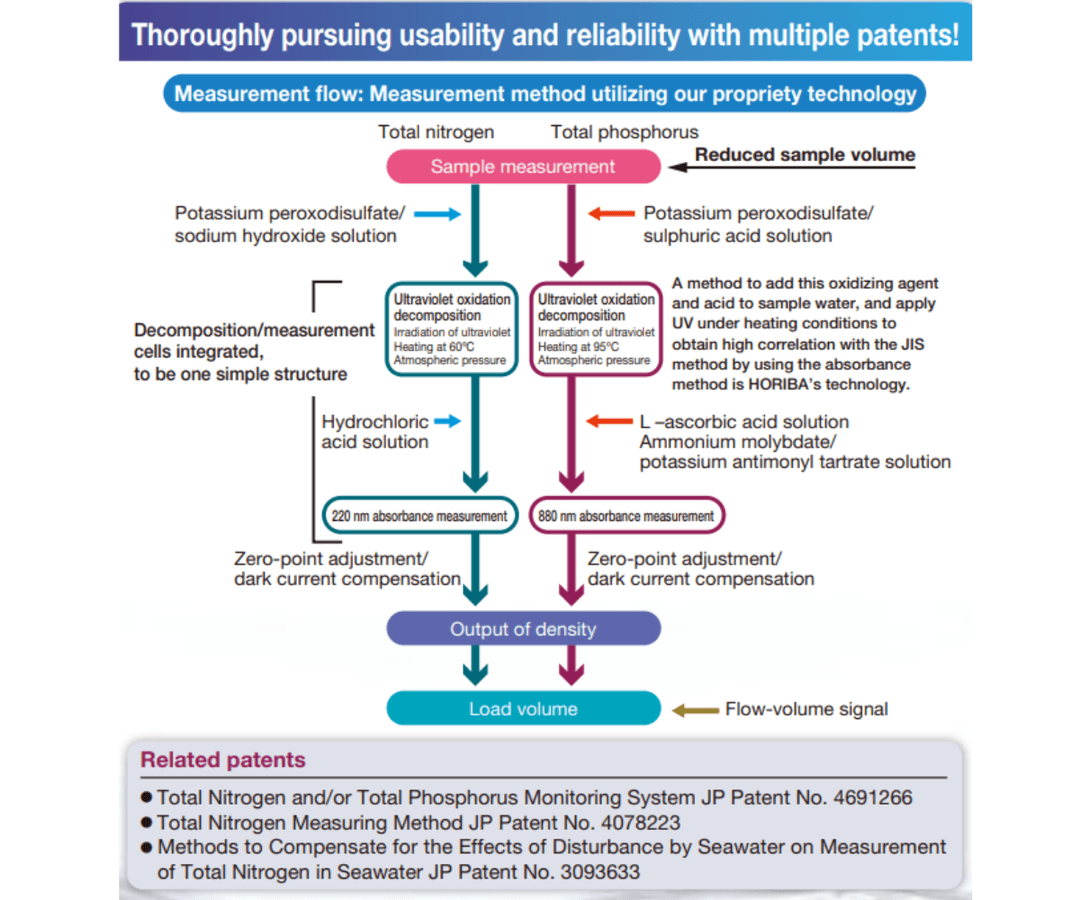
Total nitrogen measured by alkaline potassium persulfate UV oxidation and UV absorption; total phosphorus measured by potassium persulfate UV oxidation and molybdenum blue spectrophotometry.
3.
Extended Reagent Lifespan
Improved reagent stability extends replacement cycle compared to conventional models.
4.
Advanced Monitoring & Data Management
Supports analog output, contact output, load calculation, long-term memory storage (over 1 year), and data export via USB.
Applications of TPNA-500
Industrial Effluent Monitoring
Continuous monitoring of total nitrogen and total phosphorus in industrial wastewater for regulatory compliance.
Total Emission Control Systems
Supports compliance with total emission control regulations through automatic TN and TP measurement.
Environmental Compliance Facilities
Designed for indoor environmental monitoring stations with controlled ambient conditions.
Integrated Three-Component Monitoring
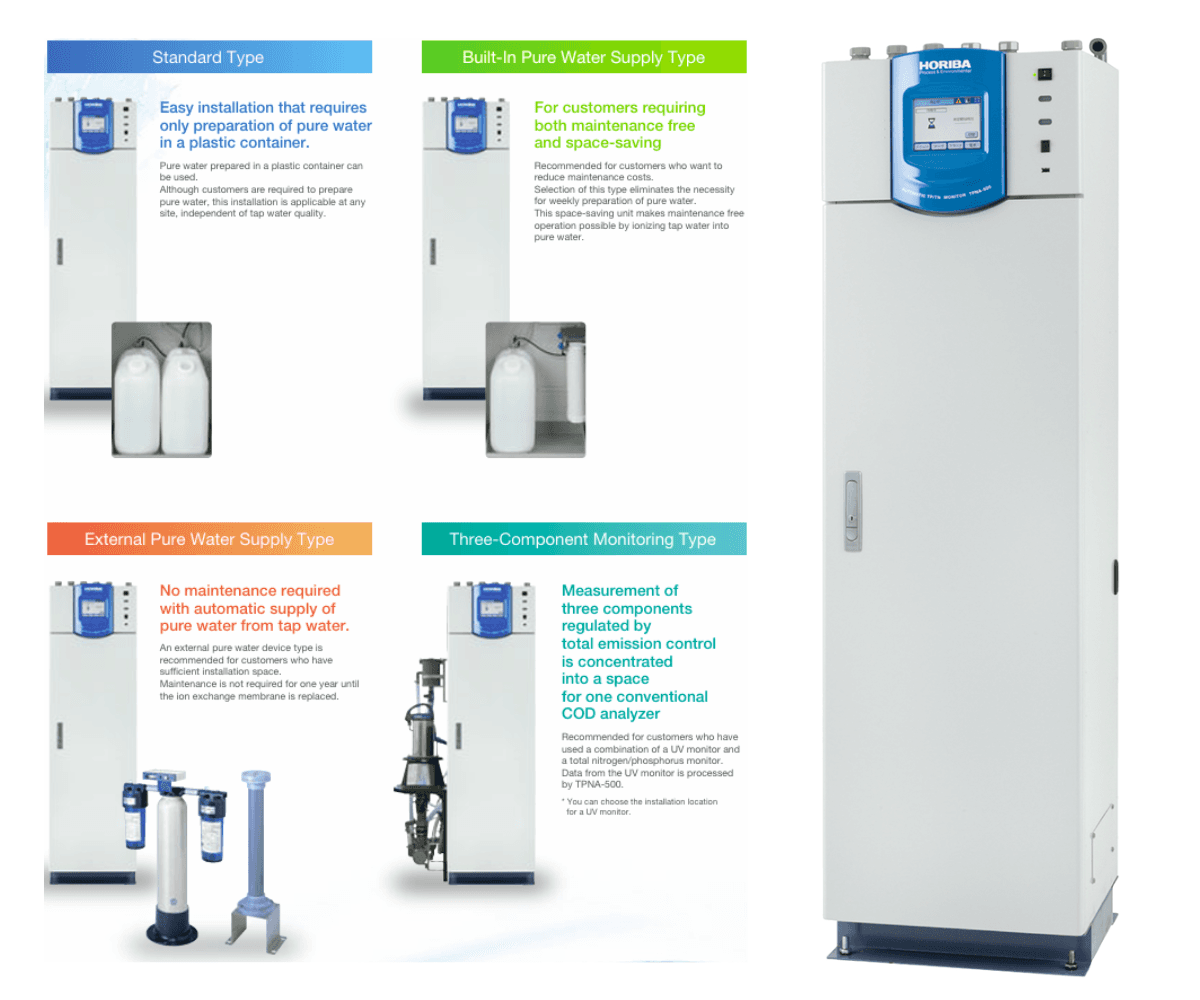
Optional configuration enables integration with UV/COD monitor for combined TN, TP, and COD monitoring.
Technical Specifications of TPNA-500
| General Specifications | |
|---|---|
| Equipment name | Automatic total nitrogen/phosphorus monitoring system |
| Model | TPNA-500 |
| External dimensions | 460 (W) × 385 (D) × 1600 (H) mm |
| Mass | Approx. 87–90 kg |
| Power supply | 100–240 V AC ±10%, 50/60 Hz |
| Power consumption | Approx. 250 VA |
| Performance | |
| Measurement range – Total nitrogen (TN) | 0–2 / 5 / 10 / 20 / 50 / 100 / 200 / 500 / 1000 mg N/L |
| Measurement range – Total phosphorus (TP) | 0–0.5 / 1 / 2 / 5 / 10 / 20 / 50 / 100 / 250 mg P/L |
| Repeatability |
Within ±3% of full scale (TN full scale ≤ 50 mg N/L and TP full scale ≤ 10 mg P/L) Within ±5% of full scale (TN full scale 100–1000 mg N/L and TP full scale 20–250 mg P/L) Condition: using standard solution |
| Measurement principle |
Total nitrogen: Alkaline potassium persulfate UV oxidative dissolution – UV absorption spectrophotometry Total phosphorus: Potassium persulfate UV oxidative dissolution – Molybdenum blue spectrophotometric method |
| Number of measurement points | 1 point (standard), 2 points (optional) |
| Number of measurement ranges | 1 range (standard), 2 ranges (optional) |
| Measurement cycle | 60 minutes |
| Installation Conditions | |
| Ambient temperature | 2°C to 40°C |
| Ambient humidity | ≤ 85% RH (no condensation) |
| Ambient environment |
Indoor installation type Overvoltage Category II, Pollution Degree 2 Flat surface not subject to vibration or external shock No dust, mist, or corrosive gas present Under atmospheric pressure No direct sunlight; well-ventilated area |
| Measurement Conditions | |
| Sample water conditions |
Temperature: 2°C to 40°C (no freezing) Flow rate: 0.5–5 L/min (when OF-3 is used) Flow rate: 5–20 L/min (when OF-30 is used) |
| Pure water usage (reference) | 43 L/month (depends on measurement range) |
| Pure water quality (customer supplied) |
Class A2 or above as specified in JIS K0557:1998 Should not contain nitrogen and phosphorus compounds |
| Supply method | Supply by tank (standard) or continuous supply by pure water equipment (optional) |
| Supply pressure | 0.1 to 0.5 MPa |
| Input / Output Specifications | |
| Analog output (number of points) |
Standard: 4 points Optional (3-component specification / 2-point meter specification): 8 points |
| Analog output (type) |
Standard: 4–20 mA DC, 0–16 mA DC (factory set to 4–20 mA DC; switchable from screen) Optional: 0–1 V DC, 1–5 V DC |
| Analog output (description) |
Standard: TN concentration, TP concentration, TN load, TP load, flow rate per hour Optional (3-component specification): COD concentration, COD load, COD instantaneous concentration Note: COD output settings depend on equipment conditions |
| Analog output (output impedance) | 500 Ω or less |
| Contact output (number of points) |
Standard: 16 points Optional (3-component specification / 2-point meter specification): 22 points |
| Contact output (type / form) | No-voltage output contact, isolated output |
| Contact output (output capacity) |
250 V AC 3 A 30 V DC 3 A (only 30 V DC 3 A is available for “Maintenance” contact) |
| Contact output (status output) | Meas., Calibration, Standby, Maintenance, SYNCHRONOUS IDLE 1, SYNCHRONOUS IDLE 2, Power, etc. |
| Contact output (alarm output) |
Hi limit alarm (TP, TN, COD), H.Hi limit alarm (TP, TN, COD), Load limit alarm (TP, TN, COD), Sample Lack, Lack Blank, Lack Reag., Lack Span, Full Drain Tank, Total Alarm 1 to 6, various meter errors, etc. |
| Analog input (number of points) |
Standard: 1 point Optional (3-component specification / 2-point meter specification): 2 points |
| Analog input (type) |
Standard: 4–20 mA DC Optional: 1–5 V DC |
| Analog input (description) | Flow rate (full scale can be set as desired), UV/COD meter concentration |
| Contact input (number of points) |
Standard: 9 points Optional (3-component specification / 2-point meter specification): 18 points |
| Contact input (type / form) | No-voltage a contact input (open collector available), isolated input (common to (-) side) |
| Contact input (electrical conditions) |
ON resistance: 100 Ω (max.) Open-circuit voltage: 26 V DC (max.) Short-circuit current: 13 mA DC (max.) |
| Contact input (functions) |
Meas. Start, Cal. Start, Modify Date, Line Select, Flow Mainte, Flow Err., Flow Power, Flow No Drain, UV/COD Mainte, UV/COD Err., UV/COD Power, etc. |
| Equipment Functions | |
| Display | Touch panel type liquid crystal (color) |
| Load calculation function |
Standard: TP/TN load calculation function Optional: COD and 2-point meter load calculation function |
| Optional function | Turbidity compensation function (TN) (turbidity compensation wavelength: 275 nm) |
| Memory function |
Measurement values: over 1 year (including daily and hourly reports) Alarm history: 500 events Calibration history: 100 events Operation history: 100 events Note: USB external memory device can be used |
| Communication | RS-485 (standard), RS-232C (optional) |
| Communication protocol | Modbus |
| Printer | Provided (paper width: 58 mm) with automatic take-up equipment |
| Reagent Consumption (Reference) | |
| Per-measurement usage |
Reagent A: 0.8 mL (capacity: 1000 mL) Solution B: 0.2 mL (capacity: 250 mL) Solution C: 0.1 mL (capacity: 250 mL) Solution D: 0.1 mL (capacity: 250 mL) Solution E: 0.19 mL (capacity: 250 mL) Solution F: 0.2 mL (capacity: 250 mL) Span solution: 50 mL (capacity: 1000 mL) |
| Replacement cycle | One month (only under certain storage/usage environment) |
Related Products
Explore other high-performance analyzers that might fit your lab’s needs.

NOT SURE WHAT YOU ARE LOOKING FOR?
BOOK A CONSULTATION
Our experts are here to guide you to the right solution. Fill out the form and we'll get in touch shortly.
Frequently Asked Questions
The TPNA-500 is an automatic total nitrogen and total phosphorus monitoring system designed for continuous measurement of TN and TP in industrial effluent and wastewater. It supports regulatory compliance, total emission control, and environmental monitoring applications.
The TPNA-500 uses ultraviolet oxidative decomposition technology: Total Nitrogen (TN): Alkaline potassium persulfate UV oxidative dissolution followed by UV absorption spectrophotometry. Total Phosphorus (TP): Potassium persulfate UV oxidative dissolution followed by molybdenum blue spectrophotometric method. This enables accurate online monitoring of total nitrogen and phosphorus concentrations.
The TPNA-500 supports multiple selectable measurement ranges: Total Nitrogen (TN): 0–2 to 0–1000 mg N/L Total Phosphorus (TP): 0–0.5 to 0–250 mg P/L Range selection depends on configuration and application requirements.
Yes. The TPNA-500 is designed as an online total nitrogen and total phosphorus analyzer with a 60-minute measurement cycle. It supports continuous automatic monitoring with data logging and load calculation functionality.
Yes. The TPNA-500 includes a built-in load calculation function for total nitrogen and total phosphorus. Optional configuration allows load calculation for COD when integrated with a compatible UV/COD monitor.
The TPNA-500 supports: - RS-485 communication (standard) - RS-232C (optional) - Modbus protocol - Analog output (4–20 mA DC) - USB external memory device for data export This allows integration with plant monitoring and control systems.
The TPNA-500 is designed to reduce life cycle cost through: - Reduced power consumption - Reduced pure water usage - Reduced waste liquid volume - Optimized reagent consumption - Extended reagent replacement cycle These features help lower operating and maintenance costs over time.
The standard configuration supports one measurement point. An optional configuration allows monitoring of two measurement points.
The TPNA-500 is suitable for: - Industrial wastewater treatment plants - Effluent discharge monitoring stations - Environmental compliance facilities - Total emission control installations It is designed for indoor installation under controlled environmental conditions.
The TPNA-500 is designed for indoor installation with: - Ambient temperature: 2°C to 40°C - Humidity: ≤ 85% RH (no condensation) - Stable surface without vibration - No dust, mist, corrosive gas, or direct sunlight - Proper installation ensures stable and reliable long-term monitoring.
Total nitrogen (TN) represents the combined concentration of nitrogen compounds present in wastewater, measured after ultraviolet oxidative decomposition. The TPNA-500 measures total nitrogen using alkaline potassium persulfate UV oxidation followed by UV absorption spectrophotometry, enabling comprehensive nitrogen monitoring rather than measuring a single nitrogen species.
The TPNA-500 uses ultraviolet oxidative decomposition to break down nitrogen compounds in the sample. After oxidation, UV absorption spectrophotometry is used to determine total nitrogen concentration. This method is widely adopted in industrial effluent monitoring applications.
Yes. The TPNA-500 Automatic Total Nitrogen/Phosphorus Monitoring System is designed for continuous monitoring of industrial effluent. It supports compliance monitoring, emission control, and load calculation for wastewater treatment facilities.
Yes. The TPNA-500 includes a built-in TN and TP load calculation function. When integrated with compatible equipment, it can also support COD-related output configuration depending on system setup.